- Blog
- >
- How to Train Your Team to Do More Than Teach Fitness
Last updated: September 23, 2026
How to Train Your Team to Do More Than Teach Fitness
With Adult-Learning Best Practices From Our Training & Enablement Specialist.
Get certified to teach Lagree, Pilates, spin, or strength, and you’ll learn how to deliver a genuinely great workout: form, cueing, safety, programming. Here’s what no certification covers: how to sell a membership without feeling pushy, how to make a nervous first-timer feel instantly at home, how to represent your brand’s specific voice and vibe, or how to deliver the exact same experience whether it’s a Tuesday at 6am or a packed Saturday.
Your best instructor was trained to teach fitness. But you’re asking them to sell, to market, to deliver world-class customer service, to be a retention expert, and so much more. And your front desk and sales team? They probably didn’t arrive with degrees in hospitality or sales either.
And here’s the part nobody warns you about: pulling that off means you have to become the teacher. On top of running the business, you’re now expected to teach a busy, part-time, adult team how to sell, host, and represent your brand, when instructional design and adult learning are entire professions most operators have never had reason to study. That’s a real gap, and it’s why we brought in an expert. Below, our own training & enablement specialist breaks down how to make training actually land. First, let’s get clear on what you’re asking your team to learn in the first place.
Certified Isn't Enough: What the Best Teams Actually Train On
A certification says someone can lead a safe, effective class. It says nothing about the other 80% of the job you’re counting on. The strongest operators treat that 80% as a real curriculum:
- Sales & conversion
- Hospitality
- Brand & voice
- Consistency
- Retention & building relationships
- Systems fluency
Now layer in reality: most of this team is part-time, juggling other jobs and other studios. None of it rubs off on its own, you have to teach it, and teach it well! Because well-trained teams retain members, protect your brand, and stay longer themselves. In a market where good people have options, training is retention.
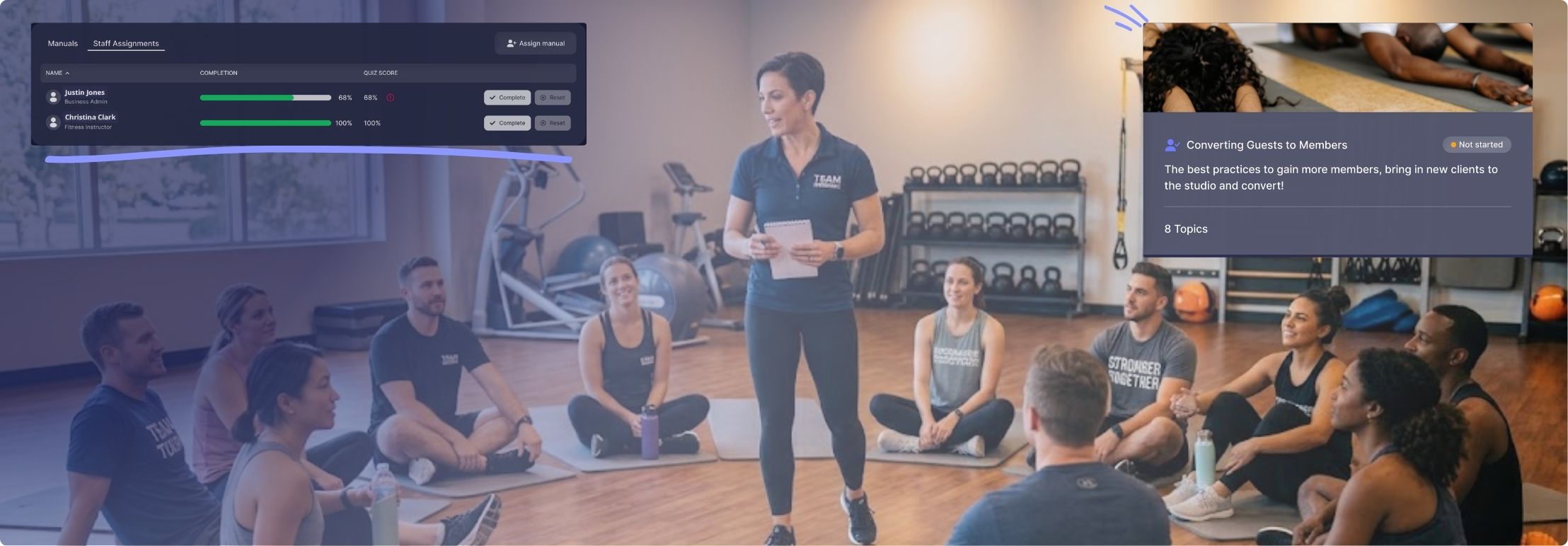
💡 Pro Tip: NetGym Training Courses let you build bite-sized lessons with video, PDFs, and quizzes that your team can take right from their phone. Every staff member gets the same strong foundation, and you can see exactly who’s completed what, so your team sells, hosts, and represents your brand the same way every shift. Book a demo to learn more →
The Content Is Yours. How You Deliver It Is a Craft.
Here’s the important part: what you train — your offers, your brand, your standards, your version of world-class — is yours, and it should be. No one can hand you your culture or tell you what your experience should feel like. That’s your edge and your decision.
But how you deliver that content is a craft of its own and it’s where most training quietly fails. You can have the best material in the industry and still lose the room in the first five minutes if it’s built like a lecture instead of like learning.
So we asked Helen Krebiehl, our Training & Enablement Specialist, who has spent years in instructional design and adult learning, for the principles that actually make training land with a busy, part-time, adult team.

Advice from Helen Krebiehl
NetGym Senior Training and Enablement Specialist
1. Lead With the "Why" Before the "What"
Adults are selective with their time, and part-time staff even more so. “Every minute has to visibly earn its place or you lose them,” Helen says. Before you teach anything, answer the questions your team is silently asking: Why should I take this? What will I get out of it? Put the purpose, objectives, and benefits up front.
Keep scenarios realistic, too. Training should address a real need your team actually has, not a hypothetical one.
2. Connect New Skills to What They've Already Lived
Adults learn best when they can relate a new concept to something they’ve already experienced. Whenever possible, start from their experience instead of from zero.
Helen’s example, for a training on welcoming new clients, starts by setting the scene:
“You’ve probably seen someone hovering near the door, checking their phone, glancing at everyone else’s setup instead of their own. You already have a read on that person before they say a word: they’re new. Think of a specific first-timer you’ve coached well. What’s one thing you did or said in those first five minutes that helped them relax?”
Then build a bridge from their experience to the new material:
“You’ve likely done at least one of these: normalized the new-ness (‘everyone feels like this their first time’), given them something to focus on so they’re not just standing there (‘feel free to put your things in a locker and settle into your spot’), or checked on their setup and made a little small talk. But most instructors skip this 30-second step…”
Then introduce the new concept, such as a check-in script. By the time they get there, it feels like a sharper version of something they already do, not a rule handed down from above.
3. One Topic, One Idea: Chunk It Down
Cognitive Load Theory tells us the brain can only hold and process a small amount of new information at once, typically around five to nine chunks. Helen’s rule of thumb: keep each topic in a course centered on one thing.
If a topic is complex, break it into separate, digestible steps rather than cramming it into one. For example, a topic called “Main Modification Categories” should have steps like “Low back pain / disc issues,” “Shoulder impingement or rotator cuff issues,” and “Knee issues,” each as its own step, not as bullet points inside a single step.
For sequencing, Helen recommends a whole-part-whole approach where it fits: show the whole task, break it into parts, then put it back together. Training someone on the studio sound system? Show a quick video of the full process, list the individual steps, then have them run through the whole thing themselves.
4. Match the Format to the Skill
Mixing media (text, visuals, video) supports what’s called dual coding: words and visuals together help the brain understand and remember more than either alone. Variety also helps keep people from tuning out. But the mix should follow what’s being learned, not the other way around. Here’s Helen’s breakdown:
|
Skill / Training Type
|
Recommended Format
|
Why
|
|---|---|---|
|
Procedural / software (e.g., booking-system how-tos)
|
Short demo video + hands-on practice ("Now you try one!"; a sandbox environment is great if you have one) + a written quick-reference (a downloadable PDF embedded in the step works well)
|
The learner needs to see it, do it, and have something to fall back on.
|
|
Policy / compliance (e.g., new-hire onboarding)
|
Written content in manageable chunks or steps
|
It's reference material and usually doesn't need to be "watched."
|
|
Soft skills (e.g., sales, hospitality, handling latecomers)
|
Modeling video + quick written pointers + role-play with real-time feedback
|
People learn new behaviors by watching someone do it well, practicing, and getting immediate corrective feedback.
|
|
Physical / instructional technique (e.g., movement-fault corrections, injury modifications)
|
Video + explainer text (why these cues?) + hands-on practice (recorded or live) + feedback
|
Same as soft skills: watch, practice, get coached.
|
5. Make It Stick Past the First View
Ebbinghaus’ Forgetting Curve shows that without reinforcement, people lose roughly 50–70% of new information within days. Here’s how Helen fights it:
- Make them recall it, and make it a little hard. Quizzing works, but only if there’s some friction. Don’t make questions too easy unless the quiz is genuinely just there to track participation.
- Have them apply it right away. Practice or implement the skill as soon as possible. The level-up: have them teach the concept to someone else. “It’s uncomfortable,” Helen says, “but that uncomfortableness forces your brain to retain information.”
- Learn as a team. Where it fits, have staff demonstrate what they’ve learned by posting a video (say, correcting a specific movement fault) to a shared team Channel for feedback.
- Space it out. Build three quizzes for a course: one to complete while taking it, one the following week, and one the following month. Longer gaps work better than shorter ones. “You want them to forget a little,” Helen explains. It sounds counterproductive, but working harder to retrieve information when you revisit it is exactly what strengthens it.
6. How to Check for Real Understanding
Finishing a course and actually being able to do what it teaches aren’t the same thing. Helen’s three ways to check for real understanding:
- Write scenario-based quiz questions instead of pure recall. Tie them to real situations your team will actually face. This is also a great way to pull in the expertise of your veteran staff.
- Have them practice and give feedback, live or via a submitted video.
- Have them walk you through it without notes. If someone can explain the process or skill to you (or a colleague) with no reference material, they’ve got it.
7. Win Over the "I Already Know How to Do My Job" Crowd
Every studio has tenured staff who roll their eyes at training. Helen’s answer is buy-in: bring them in early, during the creation process. Ask what they’d want included based on their experience, what they wish every new hire knew. When tenured staff act as subject-matter experts who help build or review training, it drastically reduces the “why am I being taught my own job?” reaction. (In NetGym Training, you can grant individual users authoring permissions on specific courses.)
For these team members, it also helps to reframe training as a refresher rather than a lesson.
8. Onboarding and Ongoing Training Aren't the Same Job
Onboarding is foundational and sequential. A new hire doesn’t have the judgment yet to know what matters most, so they need more scaffolding: a set order, more check-ins, and ideally a buddy or mentor (especially if a manager can’t be hands-on). Prioritize “need to know” over “nice to know eventually” to avoid overload. It’s fine to keep all your onboarding policies and procedures in one training; just tell new hires which topics to prioritize in week one versus the weeks after.
Ongoing training is about reinforcement and behavior change. Keep it shorter, spaced out, and triggered by real needs: a recurring mistake, a seasonal shift, or leveling up an existing skill.
What to Look for in a Training Platform
We’ve covered what to train (yours) and how to make it land (the craft above). But none of it runs without the right place to build it on, the platform your training actually lives in. Whatever you choose, look for one that keeps training:
- Consistent — every hire gets the same foundation, no matter who onboards them.
- Accessible — it lives where your team already is (their phone, between classes), not in a folder they’ll never reopen.
- Role-relevant — a front-desk hire and a new instructor don’t need the same twelve modules.
- Reinforced — it’s easy to revisit and update on a cadence, not a day-one firehose you never return to.
- Accountable — you can actually see who’s completed what, so “required” means something.
The Bottom Line
Your team wants to be great at all of it — not just the workout. Give them the training, your content, structured to actually stick, and you turn a roster of certified individuals into a team that sells, hosts, and represents your brand the same way, every single shift.
Put These Principles to Work with NetGym Training Courses
NetGym Training Courses let you build bite-sized lessons with video, PDFs, and quizzes that your team can take right from their phone. Every staff member gets the same strong foundation, and you can see exactly who’s completed what, so your team sells, hosts, and represents your brand the same way every shift.